


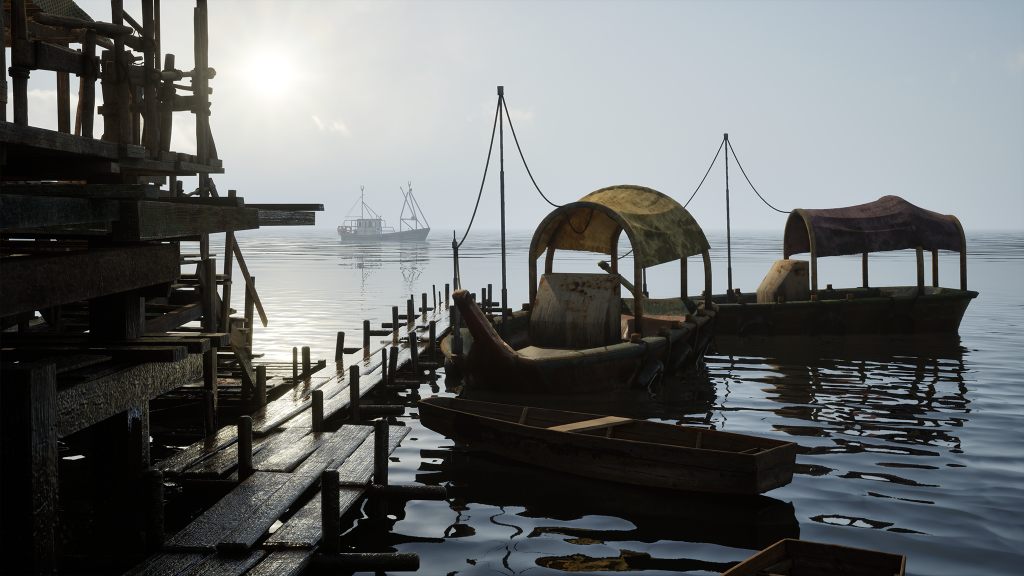
The name translates to “piercing the ocean”, reflecting how the village’s architecture pierces straight through the rising sea levels to keep the community afloat. As climate change raises sea levels, the locals cling stubbornly to their ancestral home. However, heavy marine pollution has now trapped the ocean’s surface in a thick, disorienting fog. The narrative follows a weathered fisherman, Pak Bahar, who must navigate the polluted docks and misty walkways to find his way back home.
Have you ever played a video game and skipped through the dialogues because it felt too long or slow? Just wanted to jump straight into the action and play the game?
The Walk Home challenges that by giving the player full autonomy, allowing them to uncover the story organically through just the environment without relying on direct exposition. This, in turn, aims to create a deeper sense of immersion and make the game more memorable for the player.
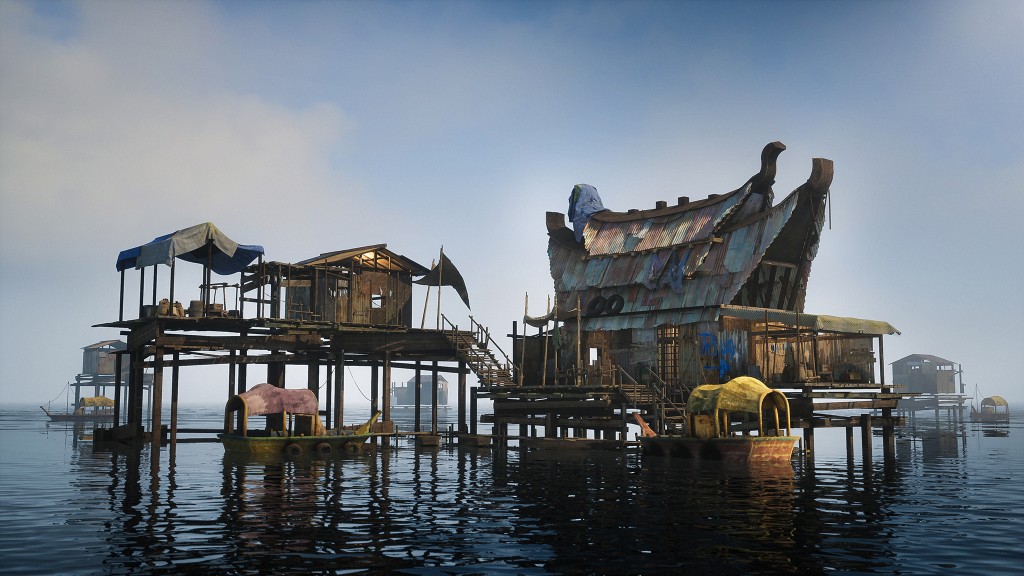
The goal was never simply to build a picturesque coastal environment, but to craft a world where history, climate, and human resilience are felt in every corner of the village. This was done by carefully researching and compiling reference images of existing fishing villages across Malaysia and Southeast Asia. Every visual choice, from the placement of props to lighting, has been crafted to relate to the narrative and help guide the player forward.
Designing a detailed, sprawling stilt village as a solo artist presents a classic production challenge: How do you create high visual density while maintaining hierarchy and contrast without spending months modeling thousands of hero assets as unique objects? The answer lies in building a flexible modular asset kit.
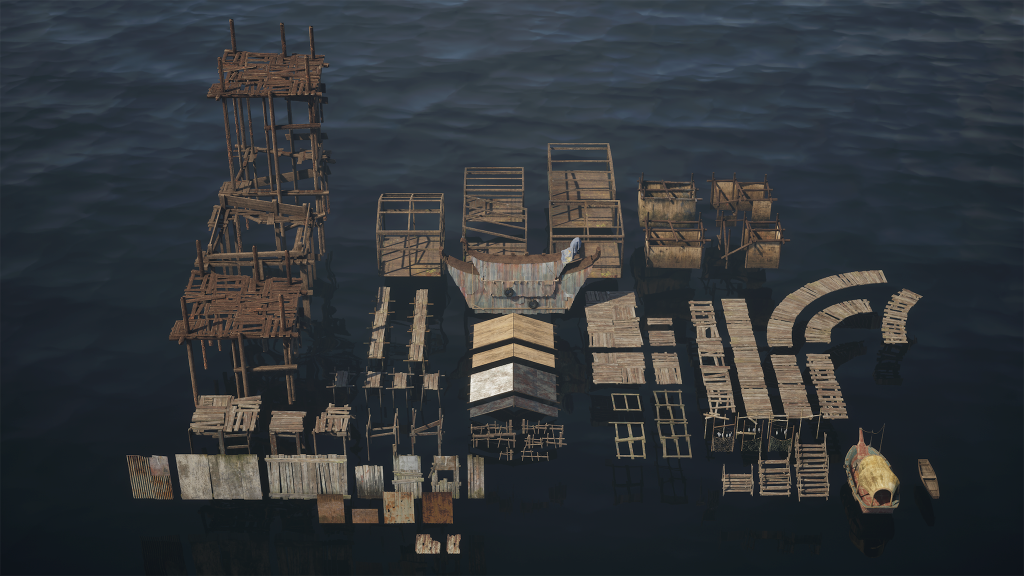
In Blender, I designed a core system of interlocking structural pieces (Figure 2) such as wooden pier segments, vertical stilts of varying heights, and wooden platforms of different sizes following the 1-meter grid. Because these pieces share uniform grid-snapping dimensions, I could easily assemble complex, multi-tiered wooden shacks and village layers directly in Unreal Engine 5, like a digital Lego set.
The real key to modularity is hiding the repetition. To prevent the village from looking repetitive, I layered unique “dressing” props over the base modular frames. Using unique texture sets for key assets further breaks up that uniform look when using modular workflows. Additionally, exposing material parameters such as hue and roughness shifts tied to world space coordinates helps create subtle visual variations in props without requiring individual unique textures. Hero props, such as fishing trap clusters or drying racks of fish, were placed at key points to give each shack an individual identity and clear purpose.
One of the areas I struggled with the most was implementing the environmental narrative across different spaces. I had to put myself in the shoes of the villagers and imagine what daily life would feel like while I’m walking through the settlement. With feedback from my peers and lecturers, I tackled the challenge using an iterative process centered on smaller vertical slices throughout the village. Breaking down the environment into distinct functional areas, such as a fishing market, residential huts, and a boatyard, made the process of implementing the narrative far more manageable and cohesive.
Designing assets for this project meant repeatedly testing how individual props functioned within the broader scene, both visually and narratively. A clear example of this iterative process would be the townhouse roof asset.

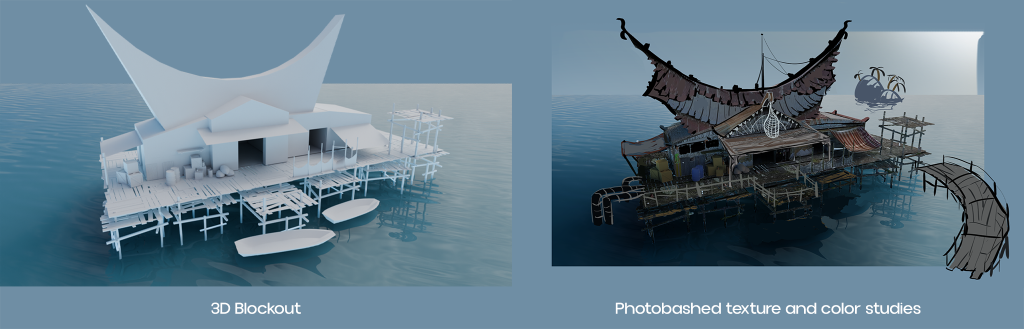

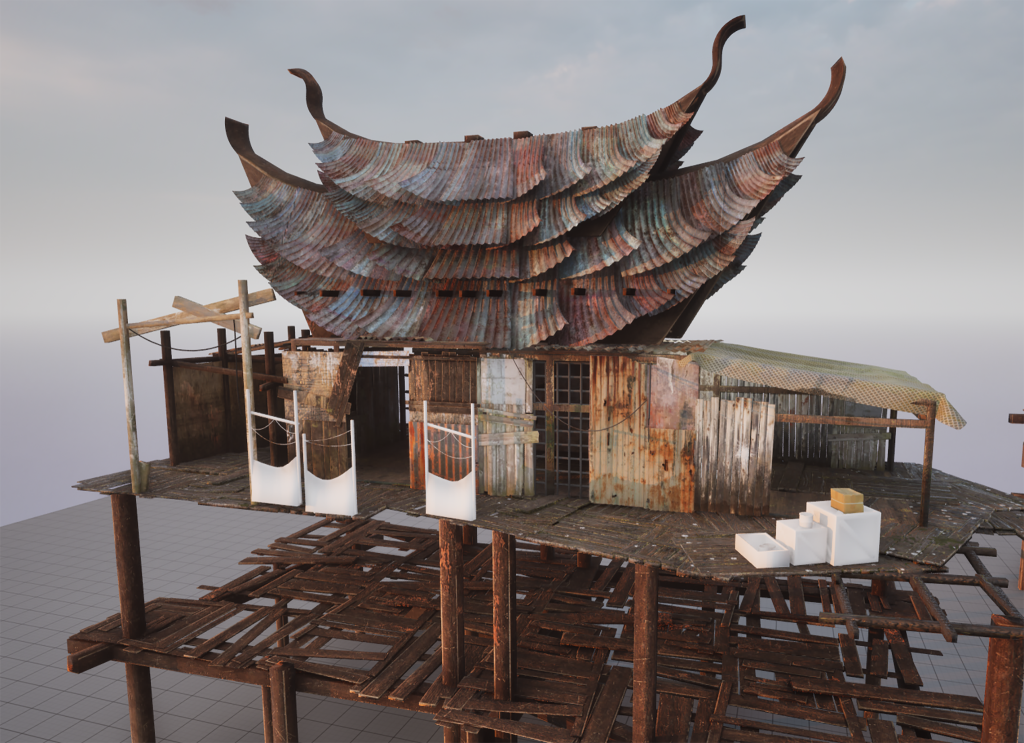

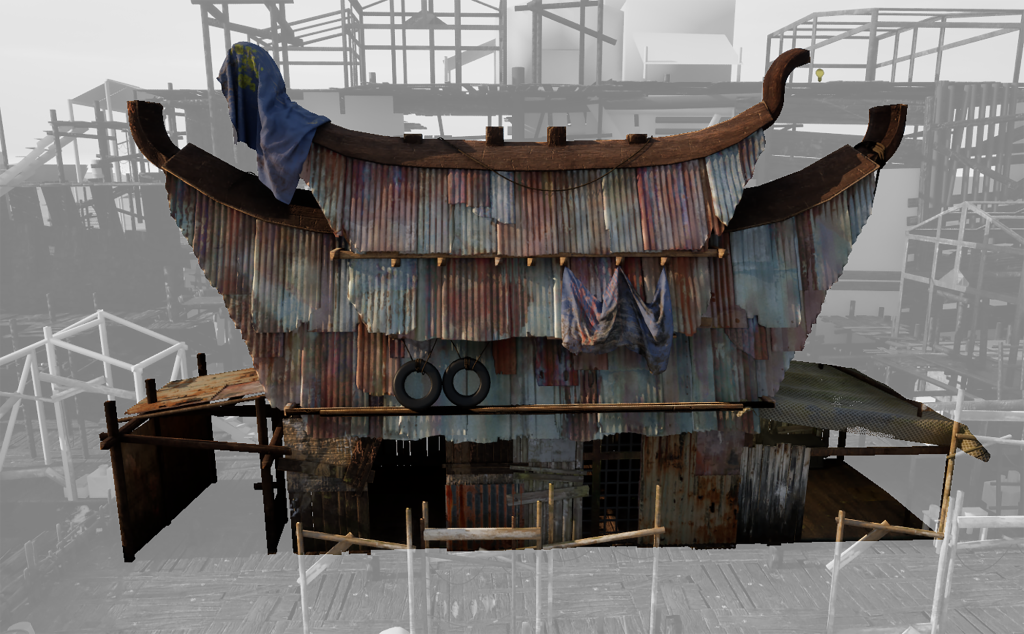
The initial models (Figure 3.0) focused purely on the silhouette and shape design, drawing inspiration from the architectural design of the Minangkabau roofs found in East Malaysia and throughout Indonesia. The first pass (Figure 4.0) used bent corrugated zinc panels to create a dramatic silhouette. However, after further research and feedback, it dawned on me that the roof panels were stacked together and shaped to direct water flow away from seeping into the house. The subsequent iterations (Figure 5.0) featured zinc roofs stacked on top of each other, which more closely reflect real-life construction while still retaining the iconic traditional silhouette.
Lighting in an environmental narrative does far more than make a scene visible; it acts as an unwritten script that guides the players’ attention. Setting the environment during the 5pm Golden Hour provided a stark visual contrast to capture the suffocating marine smog while also evoking a cinematic atmosphere with God rays piercing through.
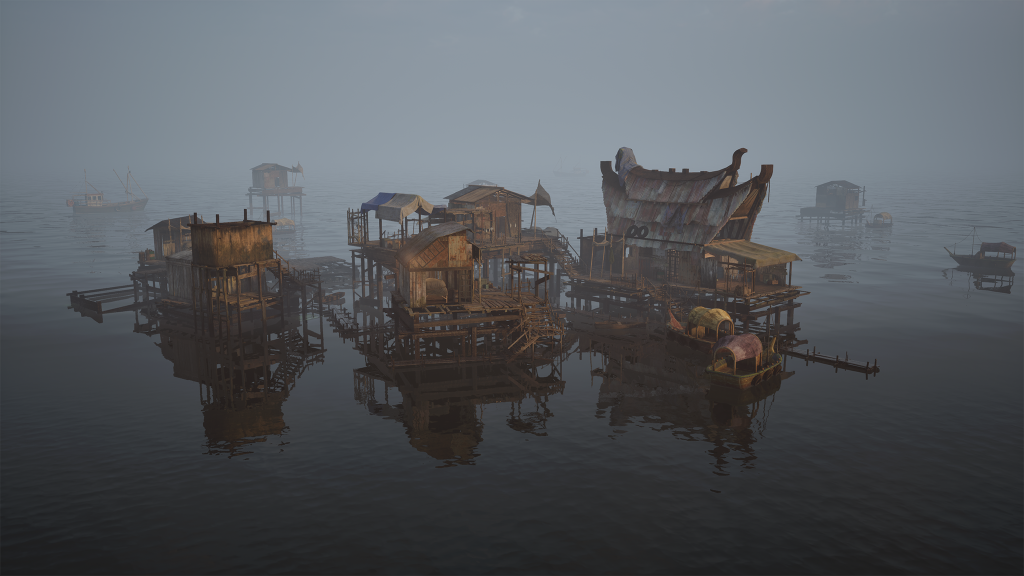
To capture that accurately, I used Unreal Engine’s Exponential Height Fog paired with custom volumetric fog volumes along the water’s surface (Figure 6.0). As low-angle sunlight cuts through the smog and ocean mist, it casts dense volumetric light shafts across the main walkways. These light shafts act as natural visual breadcrumbs, highlighting certain areas, drawing the player toward warm, lit paths, helping them navigate the disorienting coastal smog.
Developing The Walk Home was as much a lesson in artistic constraint as it was in technical execution. As a solo artist, managing every phase of production, from gathering references in the ideation stage to modeling and texturing everything in Blender and finally porting it into Unreal Engine, has forced me to adopt a production-ready pipeline that bigger studios already use.
The biggest lesson I learnt was to trust the player’s intelligence. We do not need explicit dialogue or heavy exposition to tell a compelling story. When materials and props reflect a community’s habits, and the atmosphere guides the eye, the world speaks for itself. The Walk Home, as a project, demonstrates how real-time environments can evoke emotion and convey the narrative through space alone.