
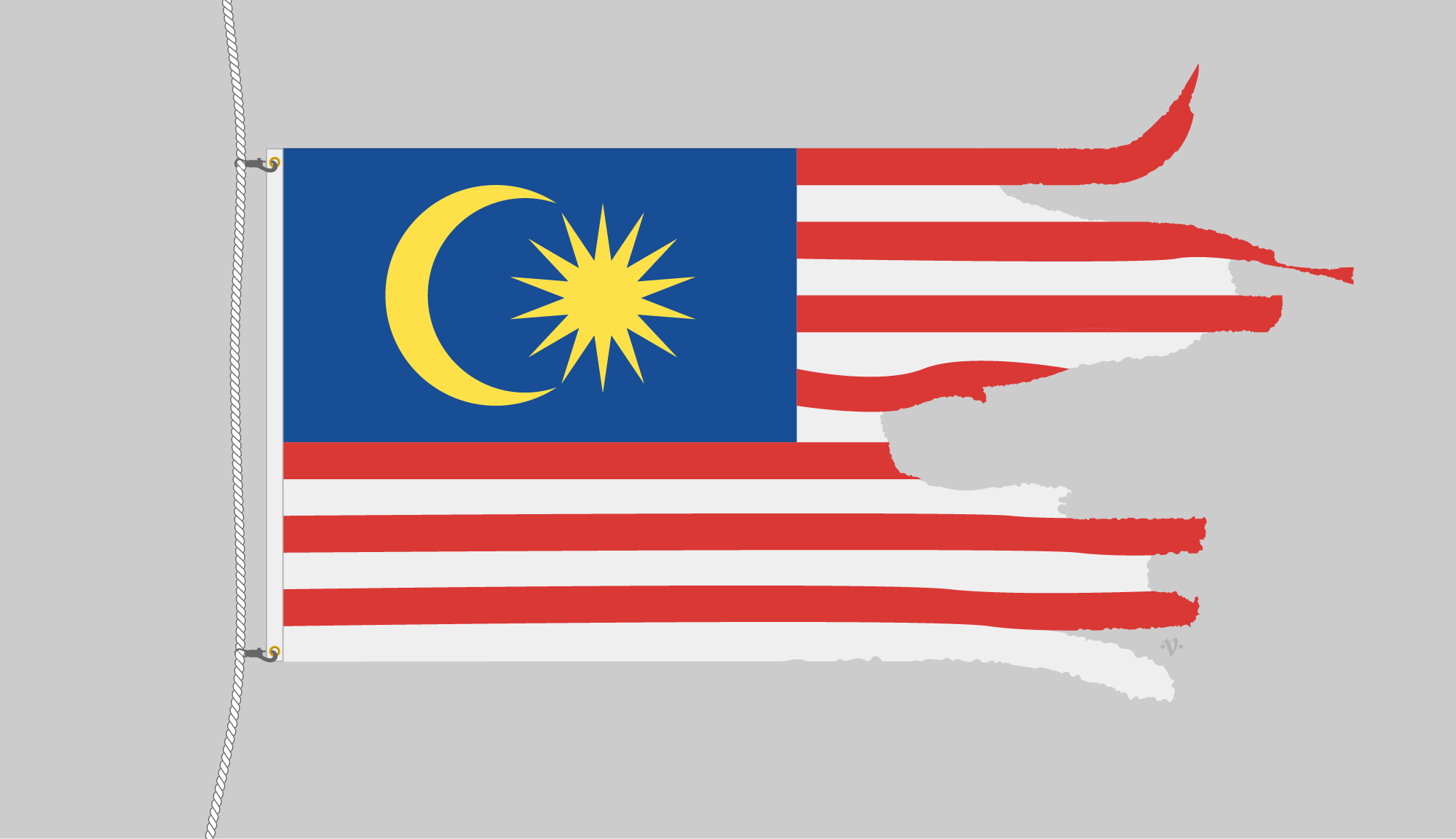

Flags are national symbols that instil pride in a citizenry when displayed from a place of honour. Consequently, protocols exist to ensure this symbol is never sullied by improper display. However, many citizens remain unaware that these protocols exist, often relying on ‘common sense’ that is helpful but not foolproof.
During Merdeka month 2025 (Independence month), two incidents involving the Jalur Gemilang being flown upside down — one at a school in Negeri Sembilan and another at a hardware store in Penang — drew significant political attention and generated unnecessary social tension. Whether arising from ignorance or honest mistake, these incidents point to a concern: carelessness and the lack of awareness.
Upon reviewing the protocols of the United Kingdom, Singapore, and Malaysia, two primary concerns regarding our national guidelines emerge:
1. Conflicting Information
Currently, two primary sources provide guidance: the Prime Minister’s Office (PMO) and the Ministry of Information (MoI). While the PMO document is largely based on the MoI’s, it is poorly crafted and frequently contradicts its source.
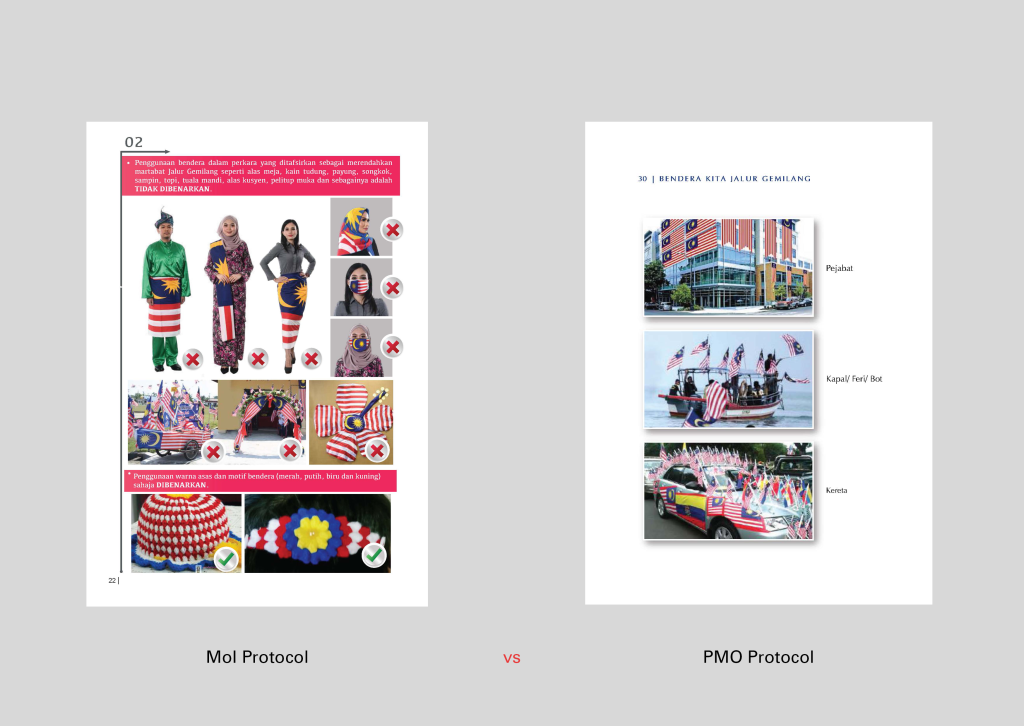
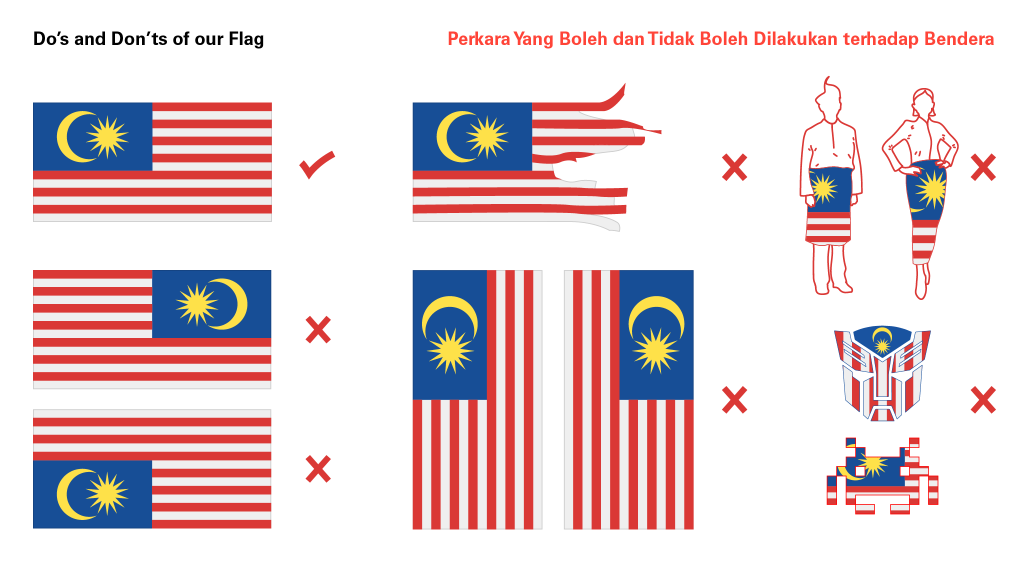
For example, the MoI protocol explicitly prohibits “creative use” of the flag on items like tablecloths, headscarves, or face masks, stating:
“The use of the flag in ways that are interpreted as lowering the dignity of the Jalur Gemilang… is NOT PERMITTED.” (p. 22)
Conversely, the PMO document features photographs that seem to encourage this exact type of creativity, showing vehicles and vessels festooned with flags in a manner the MoI would consider a diminishment of the symbol’s dignity.
2. Excessive Complexity
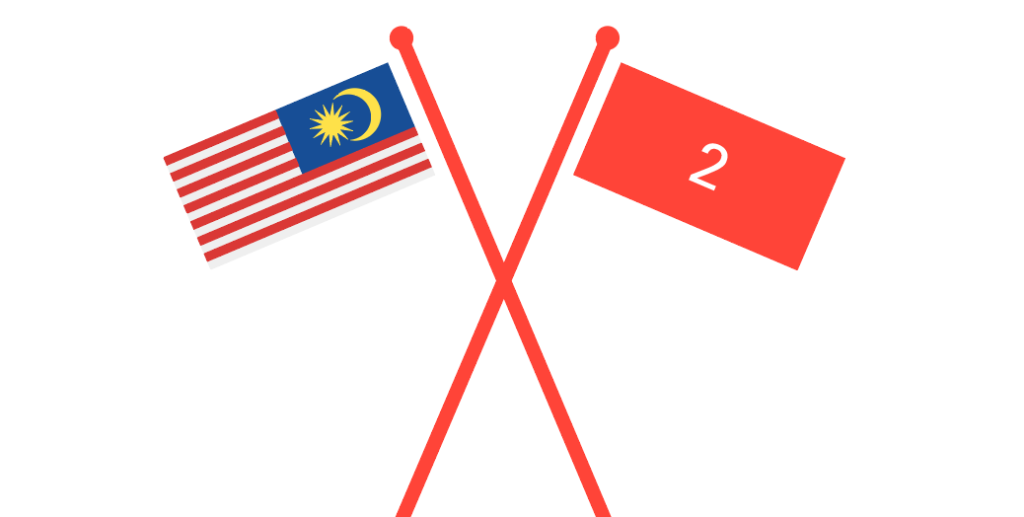
The MoI protocol is marked by a high degree of complexity, offering numerous variations in flag placement and display. While the UK and Singapore protocols prioritize clarity, the Malaysian document attempts to cater to every possible scenario—from the seniority of Royal Rulers based on accession dates to specific “crossed flag” positions where the flag is displayed in reverse—contrary to standard display.
Such complexity, while perhaps necessary for state functions (as provided for under Article 70 of the Federal Constitution), is confusing for the general public and increases the margin for error.
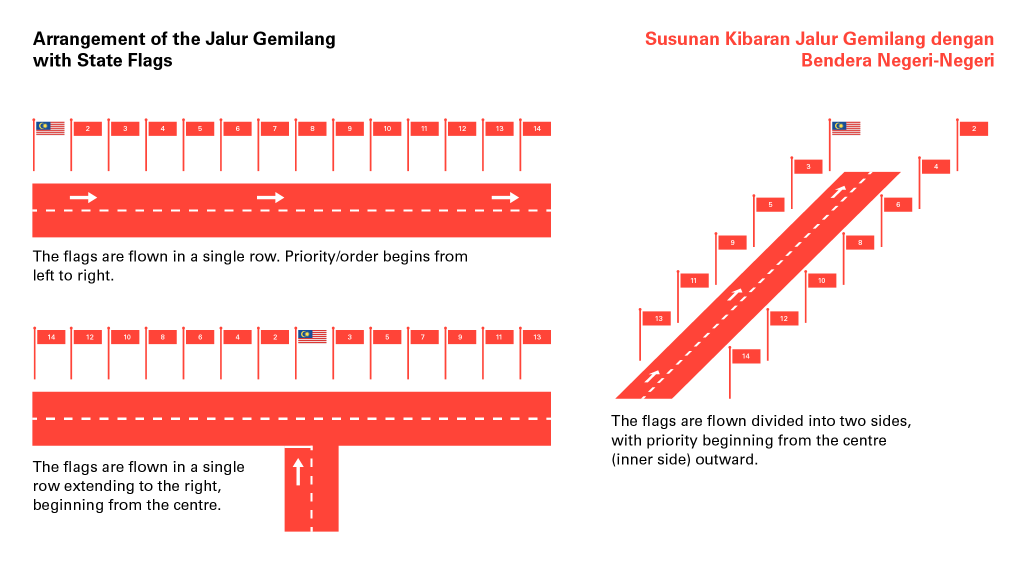
The confusion and complexity increase further when there are too many options for the same purpose i.e. like when the Jalur Gemilang is displayed alongside state flags on roadways or walkways, the protocol provides 3 options from the viewer’s perspective:
- Option 1: The Sequential Entrance – where the Jalur Gemilang is placed at the very beginning of the entrance to the road or walkway. All subsequent state flags are then arranged behind it according to their established order of seniority.
- Option 2: The Central Focus (Cross-Path Display) – if flags are displayed across a road or walkway, the Jalur Gemilang must occupy the center position. State flags are then branched out to the right and left of the national flag in their predetermined sequence.
- Option 3: The Parallel Finale – when flags line the sides of a road, the Jalur Gemilang is placed on the left side of the road. In this specific arrangement, it should be the final flag visible to the observer as they reach the end of the path.
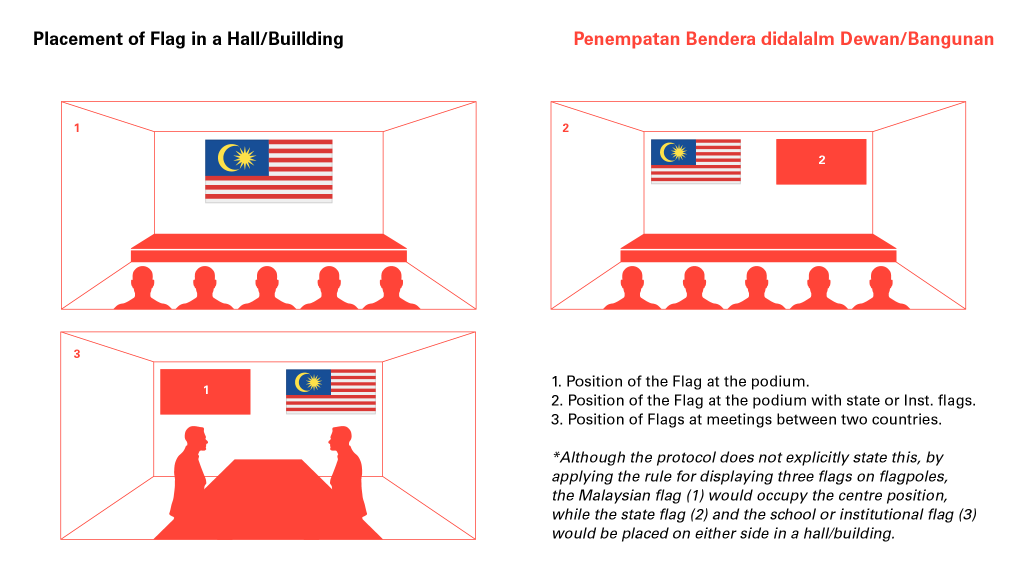
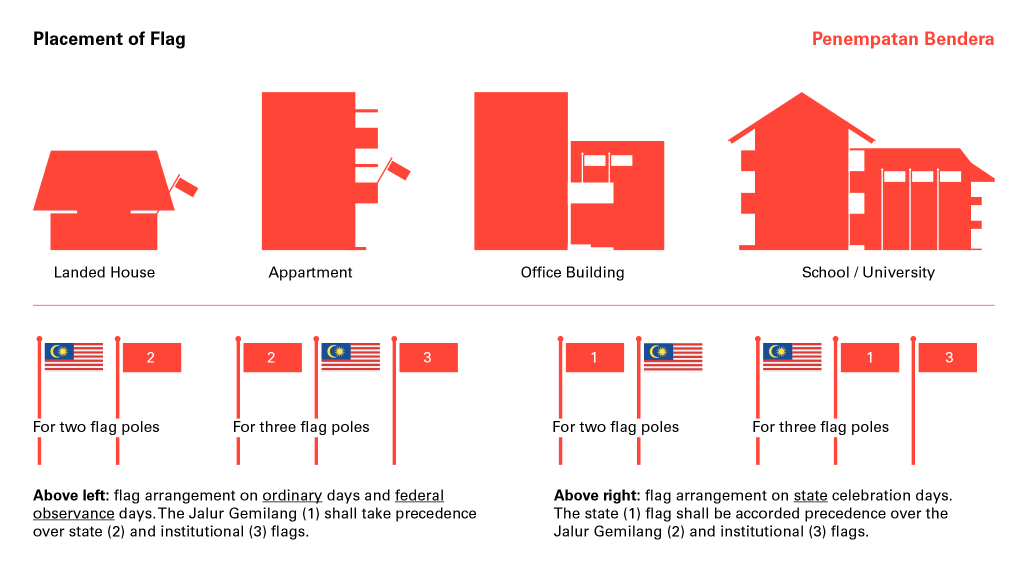
Alongside the variations described above, the protocol outlines multiple arrangements for flags displayed on two or three flagpoles, as well as configurations for indoor settings. While some of these distinctions are unavoidable and perhaps necessary, they may be unnecessarily complex for the general public seeking simply to fly the flag correctly.
Instructional Complexity
The primary issue with the current MoI text is that it lacks “at-a-glance” clarity. For instance:
- Changes to the Jalur Gemilang placement in the place of honour is subject to state festivities or the number of poles flying flags. The placement also changes when there is a formal visit from a country as courtesy.
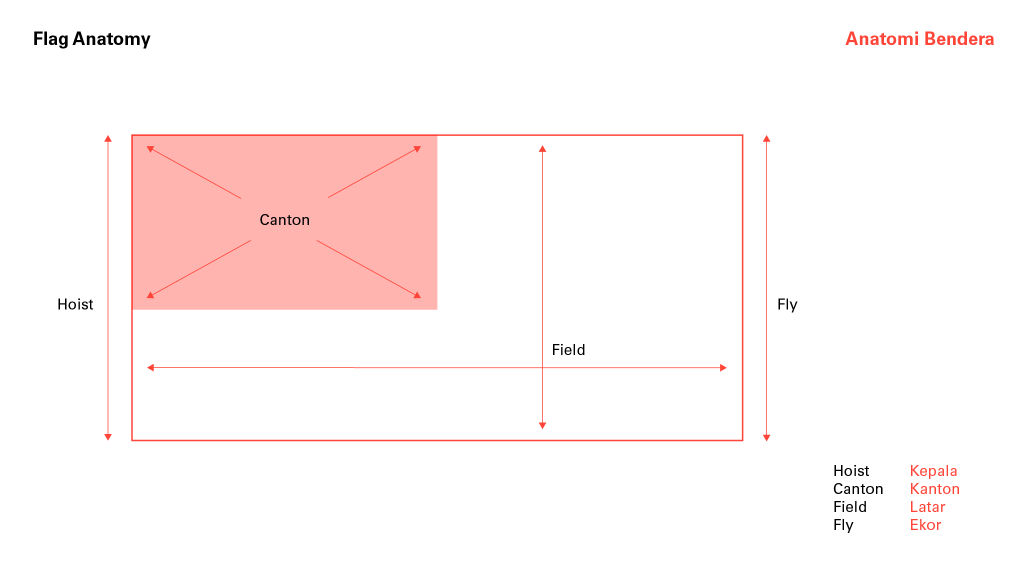
- Contradictory Hoisting: In “crossed” flag displays (figure 3), the protocol requires the flag to be reversed so the hoist is on the right. This is counter-intuitive to standard display habits where the hoist is always on the left.
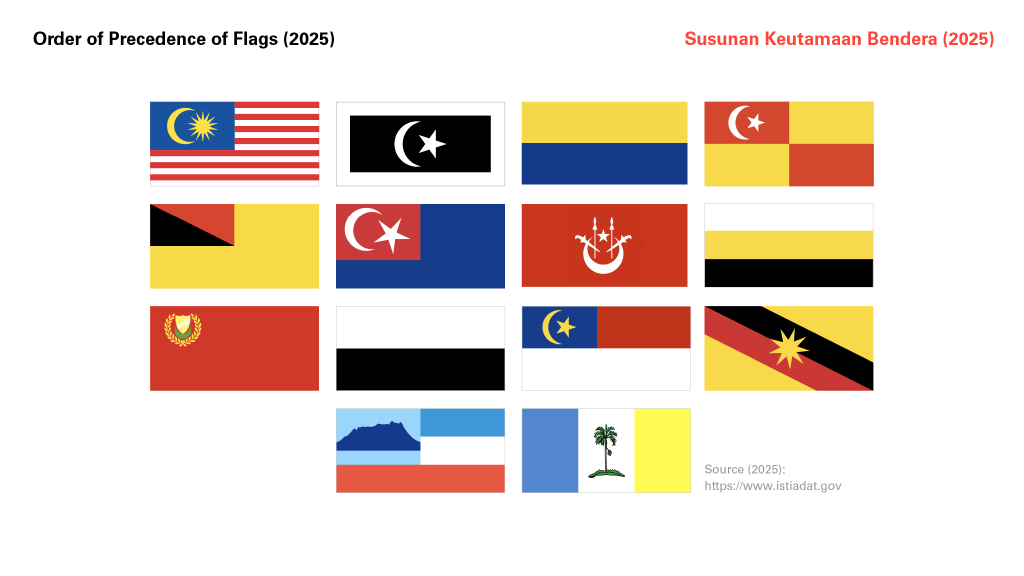
- Dynamic Seniority: The order of state and regional flags is not static (figure 4); it changes based on the accession dates of the Malay Rulers or the appointment dates of the Yang di-Pertua Negeri. Expecting the general public to track these dates to fly a flag correctly is an example of the “excessive complexity” that leads to honest mistakes.
The Solution: A Single, Structured Authority
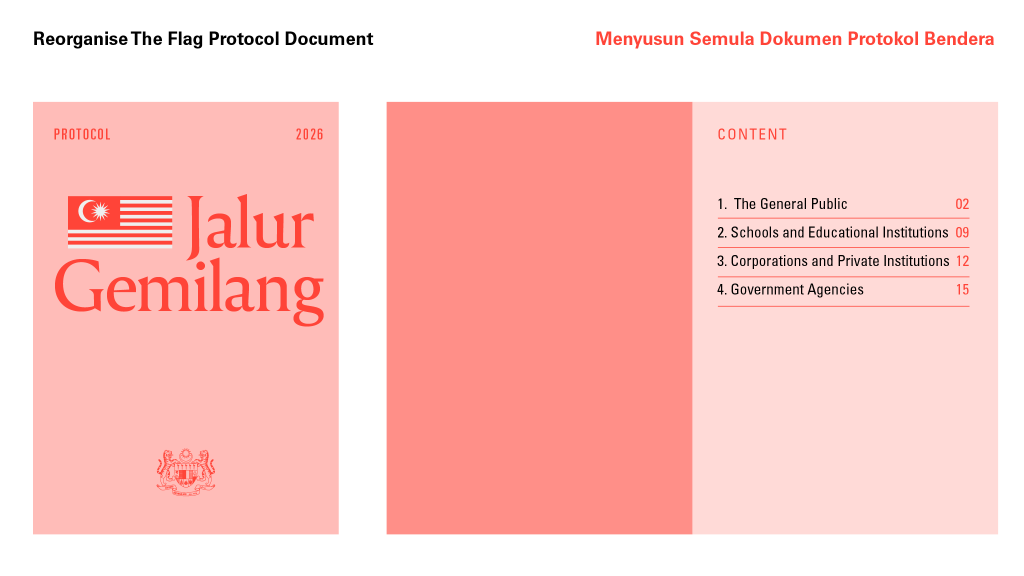
To reduce ambiguity and prevent further incidents, Malaysia should adopt a single authoritative protocol document. The MoI protocol is the more appropriate primary reference and should be reorganized into four user-specific sections:
- The General Public: Focused on residential and personal display.
- Schools and Educational Institutions: Standardizing the morning assembly and campus displays.
- Corporations and Private Institutions: For office buildings and formal corporate settings.
- Government Agencies: For royal, state and diplomatic use.
By structuring information according to the needs of the end-user, we can move away from the current buffet of content approach that leaves citizens saturated with information.
Conclusion: A Call for Protocol Modernization
The integrity of a national symbol relies not just on the respect of the citizenry, but on the clarity of the mandates governing its use. Ambiguity or ignorance of flag protocol is not merely a bureaucratic oversight; it is a catalyst for public derision and political friction.
To ensure the Jalur Gemilang is always flown with the dignity it deserves, the following actions are recommended for the Ministry of Information (MoI) and the Prime Minister’s Office (PMO):
1. Unified Authority
The government must resolve the conflicting communications between the MoI and PMO documents. A single, authoritative protocol should be established to prevent “creative uses”—such as flags festooned on vehicles or the like—that the MoI currently prohibits but the PMO appears to inadvertently encourage.
2. User-Centric Restructuring
The current protocol should be reorganized into four distinct chapters to serve different end-users:
- General Public: Simplified rules for residential and festive display.
- Schools and Educational Institutions: Clear instructions for educational environments.
- Corporations: Guidelines for private sector buildings and events.
- Government Agencies: Rigorous standards for royal, official and diplomatic use.
3. Visual-First Communication
Following the successful models of the United Kingdom and, to a lesser extent, Singapore, Malaysia’s protocol should move away from an overabundance of options toward clearer and more curated guidance. Presenting each variation with clear, high-quality illustrations would significantly reduce the likelihood of “honest mistakes” and improve public understanding.
By simplifying complexity and resolving inconsistencies, the national flag protocol can be transformed from a source of confusion into one of shared national pride.
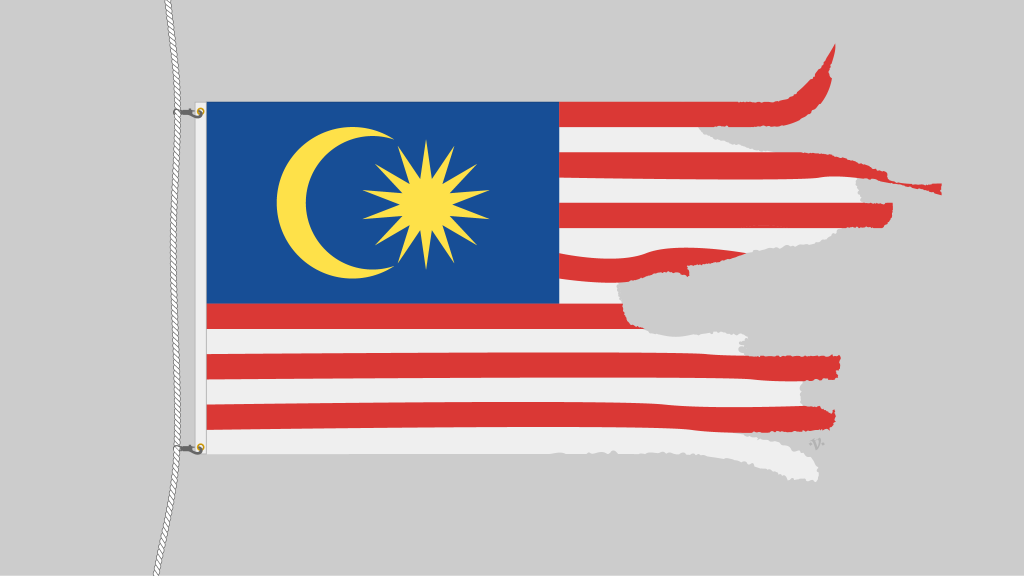
A previous article on the origins of flags and of our flag can be viewed here.
Artificial intelligence (AI) tools were used to assist with language refinement, including grammar, clarity, and sentence structure. All ideas, analysis, and conclusions remain the author’s own.